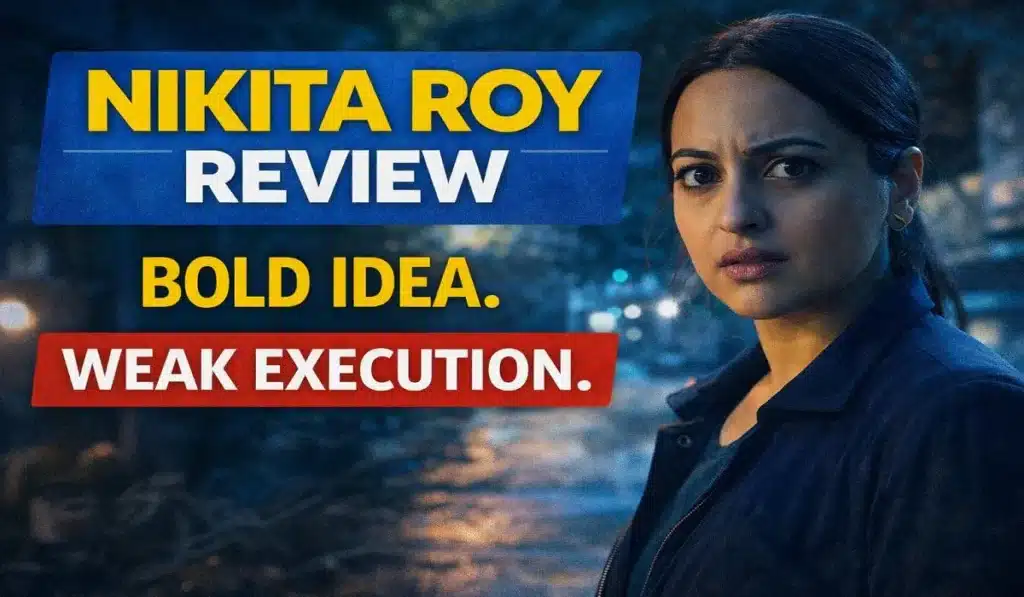
A psychological horror drama that raises important questions but struggles with execution
Nikita Roy begins with an idea that feels timely and brave; questioning blind faith, cult influence, and the fragile line between logic and belief. On paper, it promises a sharp psychological horror drama led by a strong central performance. On screen, however, the film becomes a reminder of how ambition alone is not enough without careful execution.
Nikita Roy (also known as Nikita Roy and the Book of Darkness) arrives with an intriguing premise and the promise of a layered psychological horror thriller. What it delivers instead is a film that starts on shaky ground, stumbles through most of its runtime, and only partially redeems itself through performances and intent.
This is a movie that constantly reminds you of what it could have been, rather than what it actually becomes.
Nikita Roy (also known as Nikita Roy and the Book of Darkness) arrives with an intriguing premise and the promise of a layered psychological horror thriller. What it delivers instead is a film that starts on shaky ground, stumbles through most of its runtime, and only partially redeems itself through performances and intent.
This is a movie that constantly reminds you of what it could have been, rather than what it actually becomes.
A Climax That Collapses Under Its Own Weight
If the film’s first half struggles, the climax completely loses control. What should have been a payoff turns into a rushed and chaotic sequence that feels unfinished. The ending arrives suddenly, as if the film realizes it is running out of time and forces a conclusion without resolution.
The identity crisis becomes obvious here. The film seems unsure whether it wants to be horror; investigative thriller; social commentary; or a procedural drama. This confusion ultimately hurts the storytelling and leaves the audience unsatisfied.
Performances and Ideas That Deserve Better
Despite its flaws, Nikita Roy is not without merit.
The core idea is genuinely compelling. A rationalist author confronting blind faith, cult behavior, spiritual manipulation, and the fragile boundary between logic and belief is a strong foundation. The film attempts to explore grief, superstition, and emotional vulnerability in a society that often confuses belief with truth.
Sonakshi Sinha delivers a confident and restrained performance. She carries the film with conviction and quiet strength, making this one of her more controlled and mature roles. Even when the script falters, her presence holds attention.
Paresh Rawal is understated and effective as the cult leader. He brings subtle menace and credibility, elevating scenes that otherwise lack tension. Suhail Nayyar provides decent support, though his character too suffers from limited development.
The cinematography, particularly the London sequences, adds a layer of mood and polish. The sound design and background score occasionally manage to create unease, and a few narrative twists briefly rekindle interest. For viewers who enjoy slow psychological exploration over overt horror, these moments may resonate.
Nikita Roy Movie Ending Explained – What Really Happens in the Climax
The nikita roy movie ending explained revolves around a central question the film never fully answers; was everything a carefully planned human conspiracy, or did something genuinely supernatural survive till the end?
The film closes on an unsettling note that blends rational explanations with lingering doubt, making the ending divisive but thematically consistent.
The Truth Behind the Cult and Sanal’s Death
At the core of nikita roy is Nikita’s investigation into her brother Sanal’s apparent suicide in London. As a rationalist author, she believes his death is linked to cult leader Amardev and the Tru Faith Foundation.
As Nikita digs deeper with Jolly, the film reveals that:
- Amardev uses psychotropic drugs and chemical substances to create hallucinations
- Followers experience staged hauntings and possessions induced by manipulation
- Fear, grief, and belief are weaponized to control devotees
These revelations suggest that most of the supernatural events throughout the film are manufactured illusions rather than real occult forces.
The Final Confrontation with Amardev
The nikita roy ending builds toward a psychological showdown rather than a physical one. Nikita confronts Amardev as his followers beg him to “save” her, exposing how deeply he controls their minds.
During this phase:
- Nikita experiences intense nightmares and visions linked to the Book of Darkness
- Demonic imagery and shadows blur the line between hallucination and reality
- Evidence points to Amardev silencing threats, possibly including Sanal
Nikita ultimately exposes the cult’s operations, leading to Amardev’s downfall. On the surface, logic wins and the criminal machinery collapses.
The Ambiguous Twist That Changes Everything
Just when the film seems to confirm that everything was fake, the ending takes a turn.
After Amardev’s exposure, Nikita experiences one final unexplained moment. It may be a shadow, a whisper, or a presence that cannot be linked to drugs or manipulation. This scene is deliberately brief and unresolved.
This moment suggests:
- Amardev may have unleashed something he could not control
- Blind faith may have opened the door to a real dark force
- Or Nikita herself may still be processing trauma
The film refuses to choose one answer.
Was the Ending Rushed or Intentionally Open?
Many viewers felt the nikita roy movie ending explained sequence ends abruptly. The confrontation resolves quickly, with little emotional closure or aftermath.
Critics argue:
- The climax feels hurried
- The film avoids committing fully to horror or thriller
- Character arcs end without deep resolution
Supporters believe the abruptness reinforces the theme; belief systems rarely end neatly, and truth often feels incomplete.
Nikita Roy Worth Watching or Not?
Whether nikita roy worth watching depends on expectations.
It is worth watching if:
- You enjoy psychological thrillers over jump scares
- You like stories about faith versus reason
- You prefer ambiguity over clear answers
It may disappoint if:
- You expect a full horror payoff
- You want a tightly wrapped ending
- You prefer clear genre boundaries
Final Verdict
Nikita Roy is an ambitious but uneven film. It has a solid concept, relevant themes, and strong performances, especially from Sonakshi Sinha and Paresh Rawal. Unfortunately, weak writing, inconsistent pacing, lack of genuine scares, and a rushed climax prevent it from reaching its potential.
If you are interested in stories that explore rationalism versus superstition, or if you are a fan of Sonakshi Sinha, the film may be worth a one time watch. For everyone else, expectations should remain modest.
Rating; 2.5 to 3 out of 5
A film with something to say; but not enough clarity to say it well.
As of now (January 13, 2026), the movie is available to watch on the OTT platform JioHotstar (also accessible via OTTplay Premium), where it premiered digitally on January 12, 2026.
To read more movie reviews follow Being Maverick.